The lowest number at bid day is not the cheapest number once a scope gap surfaces. A scope gap is work that exists on the drawings, or in the sequence of the job, that never makes it into a price. It does not announce itself at bid opening. It shows up three months later as a change order against your own slip, or as a field condition that eats the labor you budgeted.
The fix is not simply more careful takeoff. It is a way of reading the drawings for the seams where scope likes to hide, then pricing the seams deliberately.
The short version
A scope gap is a line item that lives in your head as “obviously included” and in the drawings as a condition you did not price. The expensive ones share three traits:
- They sit at a transition — wall to wall, wall to storefront, glass to backup — where no single drawing sheet owns the detail.
- They are sequence-dependent — the work is priced, but only if the adjacent trade finished first.
- They are cheap to name and expensive to discover. A missing anchor is twelve dollars a piece, until you are rigged on the scaffold and the anchor that was supposed to be there is not.
The rest of this post is where those gaps live in a building-envelope bid.
The five scope gaps that eat envelope bids
Anchoring and structural backup
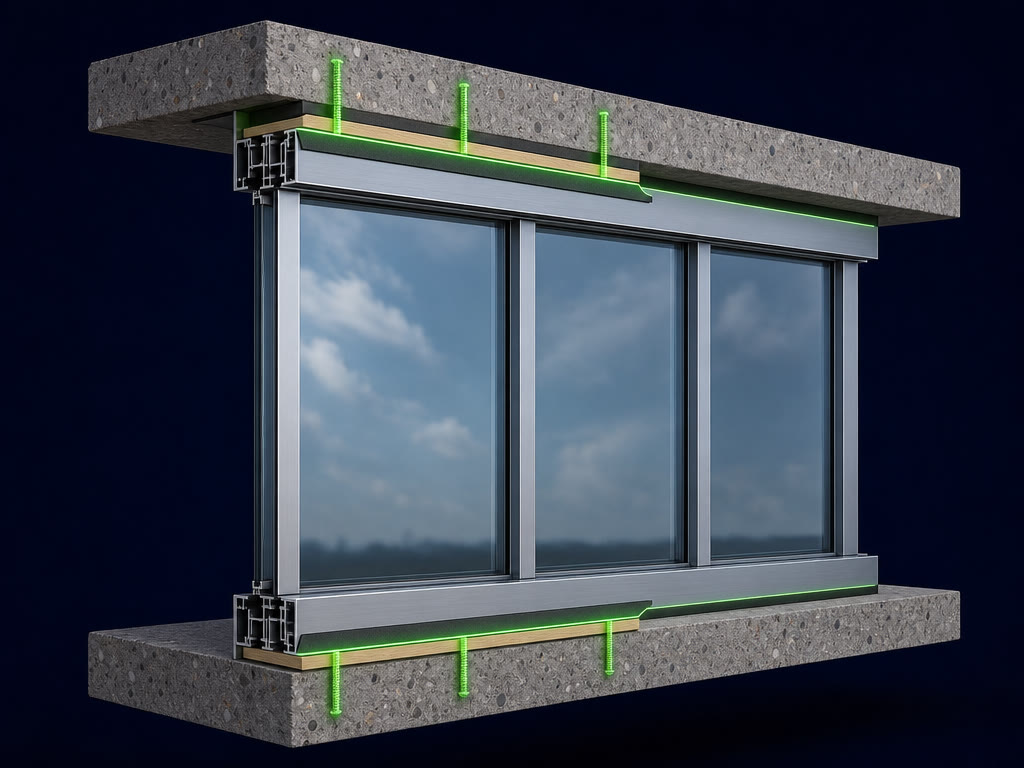
A storefront or curtain-wall frame does not float. It anchors to a slab edge, a steel angle, or a stud backup — and all three are someone’s scope. The glazier prices the frame and assumes the connection to the structure is a separate contract, or that the steel was already laid out to suit the frame. If the drawings do not detail the anchor points or the deflection allowance between the frame and the backup, that connection is a gap. It is real money, and it lives on no schedule.
Substrate and opening tolerance
The door and window schedule names a product and a rating. It does not name the condition behind the opening. A CMU opening and a steel-stud opening receive a storefront system differently, and an existing opening that measures out-of-square takes field time a quote never carried. The gap appears when the unitized frame built from a drawing dimension meets an actual opening that is a half-inch off plumb. Someone absorbs it. In an envelope bid, that someone is usually your margin.
Transitions, flashing, and continuity
The expensive gaps cluster at interfaces: glass to masonry veneer, storefront to spandrel, sill pan, through-wall flashing, the sealant and backer rod line at the parapet. No single sheet owns these details, so each trade prices the part on its own sheet and nobody prices the seam. Water intrusion scope is the classic example — it is almost always a gap at a joint, not in a takeoff. Whether or not the code requires a specific rain-screen detail, the joint is real and has to be made watertight.
Glazing type by location
A schedule may say “DP-65 impact” once and let you price the same lite across every opening. But sidelites, transoms, vision panels at the storefront, and the spandrel condition do not all get the same glass, and a single mis-priced lite type multiplies across the project. If you are new to how design pressures shape glazing choice, run the relationship between the wind load and the product you quote before you price.
Sequencing and remobilization
The frame cannot be set until the rough opening is framed, squared, and ready, and the packer and sealant cannot run until the adjacent masonry or drywall is done. If your bid priced one clean pass of the glazing tower and the field has to mobilize twice because the rough opening was not ready, that is a gap even though every line item on your sheet is correct. Sequencing gaps are the ones estimators argue about hardest, because both sides did the work they priced.
The arithmetic hides the confirmation
Here is what a single gap looks like with real quantities. Twenty storefront openings, four anchors per opening, twelve dollars apiece all-in for the anchor, the placement, and the fitting: twenty times four times twelve is $960. That is not a headline number. It is invisible until the anchors are not there, and then it becomes a mobilization, a re-sequence of the glazing contractor, and a two-week snag on a three-month program. The discovery is always more expensive than the item.
That is the pattern worth internalizing: gaps read small on a bid sheet and large in the field, because the field cost is not the item — it is the re-work around it.
Why the schedule of values will not protect you
The schedule of values divides your contract into pay items, but it reflects how you chose to price, not what the drawings actually contain. It is a cash-flow document, not a scope check. If a seam was never brought into the estimate, no schedule of values will surface it. Treat the schedule of values as the last step of a scope review, not the first.
Catching gaps before the award
Scope review is a habit, not an event. Four checks catch most of it:
- Build the envelope package from the wall sections, not the schedule. The door schedule tells you which product; the wall section tells you what it meets. If the two do not line up, that is where the gap is.
- Walk the transitions one at a time. Price each seam deliberately — frame to backup, frame to veneer, sill to substrate — instead of trusting that “the detail is standard.”
- Give every subcontractor the same explicit scope list, then level the bids. A low number that is low because it skipped the backup connection is not a bargain. Bid leveling exists to surface exactly this. If you do not level, you are comparing different scopes and calling the difference price.
- Put the assumptions in writing. The estimate that flags its open items beats the estimate that hides them, on bid day and at closeout alike.
Why this is a process problem, not a diligence problem
None of this requires a brilliant estimator. It requires a repeatable way to read drawings for seams and a workflow that forces the seams onto a price. That is why an estimating operation that systematizes scope review wins the jobs it actually keeps, and why the same handful of gaps tax the shop that fights them by memory every bid. If you are carrying scope in your head instead of in a checklist, the fix is process, not more hours.