People use “impact-rated” as if it were a single yes/no. It is not. It is the outcome of three separate protocols — TAS 201, TAS 202, and TAS 203 — each aimed at a different way a hurricane actually breaks an envelope.
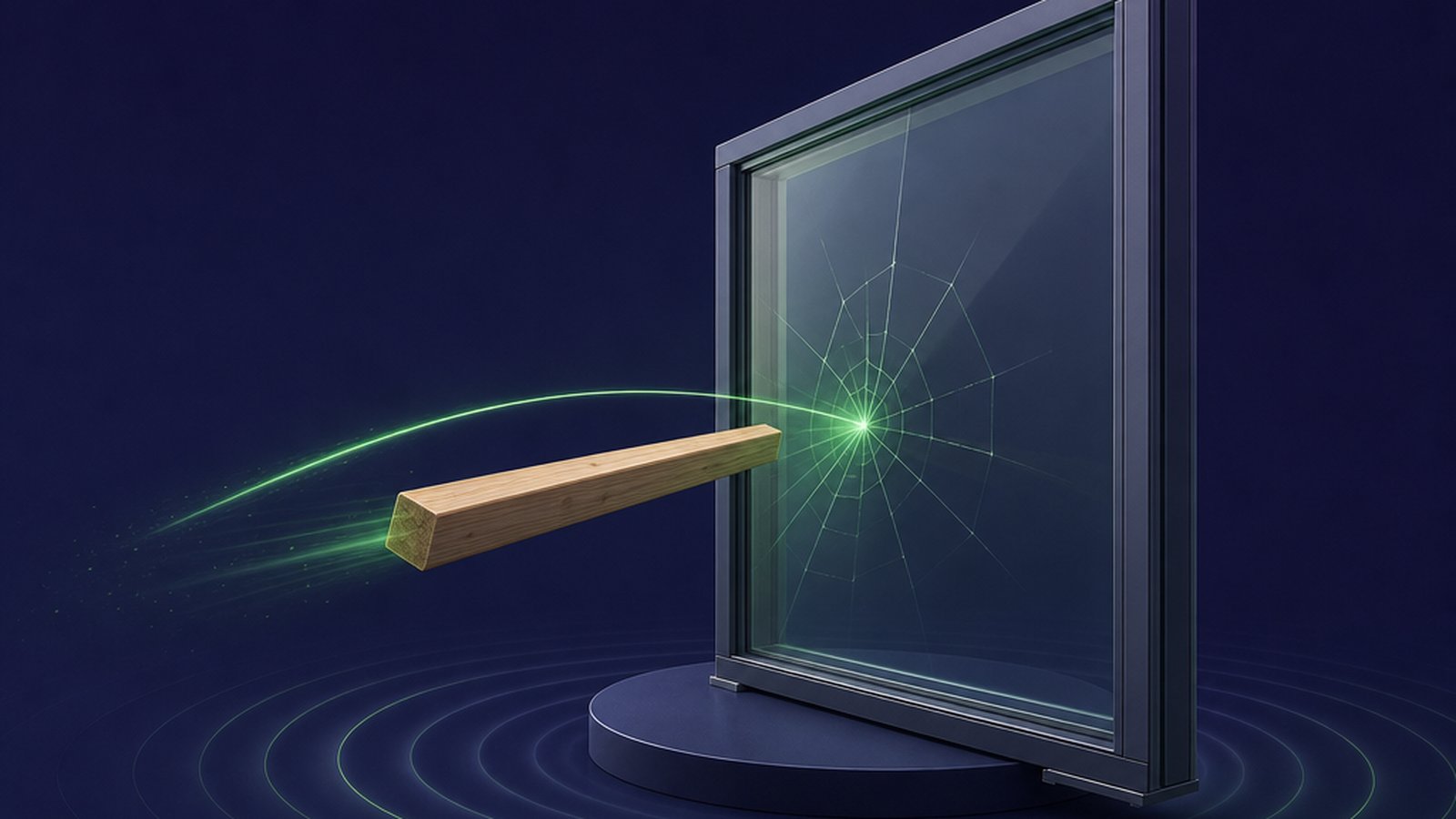
Those three acronyms are the Testing Application Standards that sit behind almost every window, door, and shutter approval in the High-Velocity Hurricane Zone. Read any Miami-Dade test report and you will see all three stacked on top of each other.
The short version
- TAS 201 is the impact test. A missile hits the product, and the product has to survive it.
- TAS 202 is the uniform static air pressure test. Steady positive and negative pressure push and pull the product to prove structural capacity.
- TAS 203 is the cyclic wind pressure test. After an impact, thousands of alternating pressure cycles load the specimen to expose fatigue and seal failures.
The three map to the three phases of a storm on a building: debris hits the glass, sustained wind loads the frame, and gust cycling works the damage loose.
Where the TAS series comes from
The protocols were written by Miami-Dade County in the mid-1990s, in the wake of Hurricane Andrew, and the county still administers the testing program through its Board and Code Administration Division. The Florida Building Code adopted them as the test methods for the High-Velocity Hurricane Zone — Miami-Dade and Broward — where they are referenced out of FBC Building, Section 1626. A product sold as HVHZ-compliant carries approvals that trace back to these three standards.
For a full walk of how that approval shows up on paper, read how to read a Miami-Dade NOA — this post is about the tests themselves.
TAS 201: the impact test
TAS 201-94, Impact Test Procedures, defines how a specimen is hit. It is Miami-Dade’s own test method, but it borrows its missile-level naming from the national standard, ASTM E1996 — which is where the “Level D / Level E” labels come from. There are two missile classes, and they are not interchangeable:
- Large missile — a nominal 2×4 timber, roughly 9 pounds (4.1 kg), fired from an air cannon at 50 feet per second.
- Small missile — solid steel balls of 2 grams, about 5/16 inch in diameter, launched at 130 feet per second.
The large missile simulates the debris that sits low to the ground in a storm — the 2×4 from a construction site, the fencing, the loose roof member. The small missile represents the gravel and roof ballast that a mature wind field carries high up. Which one applies is set by elevation, not preference: FBC Building Section 1626.2 places the large-missile test on openings within 30 feet of grade, and Section 1626.3 puts the small-missile test on everything above 30 feet (9.1 m). Heavy debris does not get carried that high; small, fast debris does.
The missile scale: A through E
ASTM E1996 defines five missile levels. In the HVHZ, only two of them govern a window or door opening:
| Level | Missile | Speed | Where it applies |
|---|---|---|---|
| A | 2 g steel ball | 130 ft/s | The small-missile test (above 30 ft) |
| B | 2 lb 2×4 | 50 ft/s | Lightweight projectile — not used for wall openings |
| C | 4 lb 2×4 | 40 ft/s | Medium missile — lower wind zones, not Florida walls |
| D | 9 lb 2×4 | 50 ft/s | The standard large missile (within 30 ft) |
| E | 9 lb 2×4 | 80 ft/s | Enhanced — essential facilities (Risk Category IV) |
Two details matter most in practice. First, Level D vs. Level E is the difference between a normal building and an essential facility. FBC Building 1626.2.4 raises the large missile from 50 ft/s to 80 ft/s for Risk Category IV essential facilities — hospitals with emergency services, fire and rescue stations, designated emergency shelters, power stations, and the like. A window approved for a normal building at Level D is not automatically approved for the police station next door at Level E; the higher-speed impact is a different, harder test.
Second, the A–E naming is why “impact-rated” on a product sheet can mislead: Level A is not a weaker large missile — it is the small-missile test under a different name — and Levels B and C never govern a Florida wall opening at all.
Impact is not a single shot at one point. The standard dictates how many specimens get hit and where — the standard has to represent the whole opening, not its strongest corner. After the impacts land, the damaged specimen moves on to cyclic loading.
If you are deciding between impact classes for a specific project, the two things to get right are the elevation band (which picks large vs. small missile) and the risk category (which picks Level D vs. Level E). Both are easy to misread off a product sheet that just says “impact-rated.”
TAS 202: the uniform static air pressure test
Before a product can be impact-tested, it has to prove it can carry a static wind load. TAS 202-94 applies steady positive and negative air pressure across the specimen, and the test is run at the design pressure the approval will claim. This is the structural test — it establishes that the assembly, its frame, and its anchorage hold together under a sustained push and a sustained pull.
This is the test that produces the positive and negative design pressures you see on an approval, and it is why that positive and negative design pressure split is not cosmetic. The +100 psf number on the left and the -100 psf number on the right are the loads the product was actually tested to hold, in each direction, before any debris was involved.
TAS 203: the cyclic wind pressure test
This is the test that separates a lab sample from a building. TAS 203-94 loads an already-impacted specimen through thousands of alternating positive and negative pressure cycles — the gust sequence in FBC Building, Table 1626. Where TAS 202 is one sustained load, TAS 203 is the fatigue test: it works the hairline crack, loosens the fastener, and pulls the seal that a single static load never reveals.
Real hurricanes do not blow at one steady pressure. They gust, reverse, and pull in the opposite direction as the storm passes. The cyclic test is an attempt to reproduce that on a specimen that has already taken its hit — because in a real storm, the window that survives the debris then has to survive the hours of cycling that follow with a compromised assembly.
What the sequence means on a submittal
The three protocols do not run in isolation. The order matters:
- The product proves its static structural capacity (TAS 202).
- It takes its debris impacts (TAS 201).
- The damaged specimen survives cyclic pressure (TAS 203) — which is why you will often see “TAS 201/203” grouped together on a test report as a single combined run.
An independent, Miami-Dade-certified laboratory runs the tests and issues the report, and the county reviews it before the product earns an approval.
For you, the practical read is this: when a supplier hands you an “impact-rated” window, ask what the test report actually lists. An approval that claims a large-missile rating should trace to a TAS 201 report with the large missile specified — not the small one. The static pressures should match what your project requires at that opening, and that means checking them against the structural drawings, not the product sheet. If you are putting a product into an opening that needs more positive or negative pressure than the approval tested, the impact rating does not save you.
That matching — test report, approval, project pressure, mounting condition — is where submittals go wrong, and it is exactly the kind of check that rewards a process over a person re-reading a folder of PDFs each time. If you are managing envelope approvals by hand, it is worth looking at what a structured compliance workflow looks like before the next substitute product lands on your desk. To see how the tested pressures from these protocols show up in a real submission, read how design pressure drives a window submittal, and screen an opening against a rated product with our free wind-load calculator.